Where's My Finger?
The poll wanted a vote. It got a catalog.

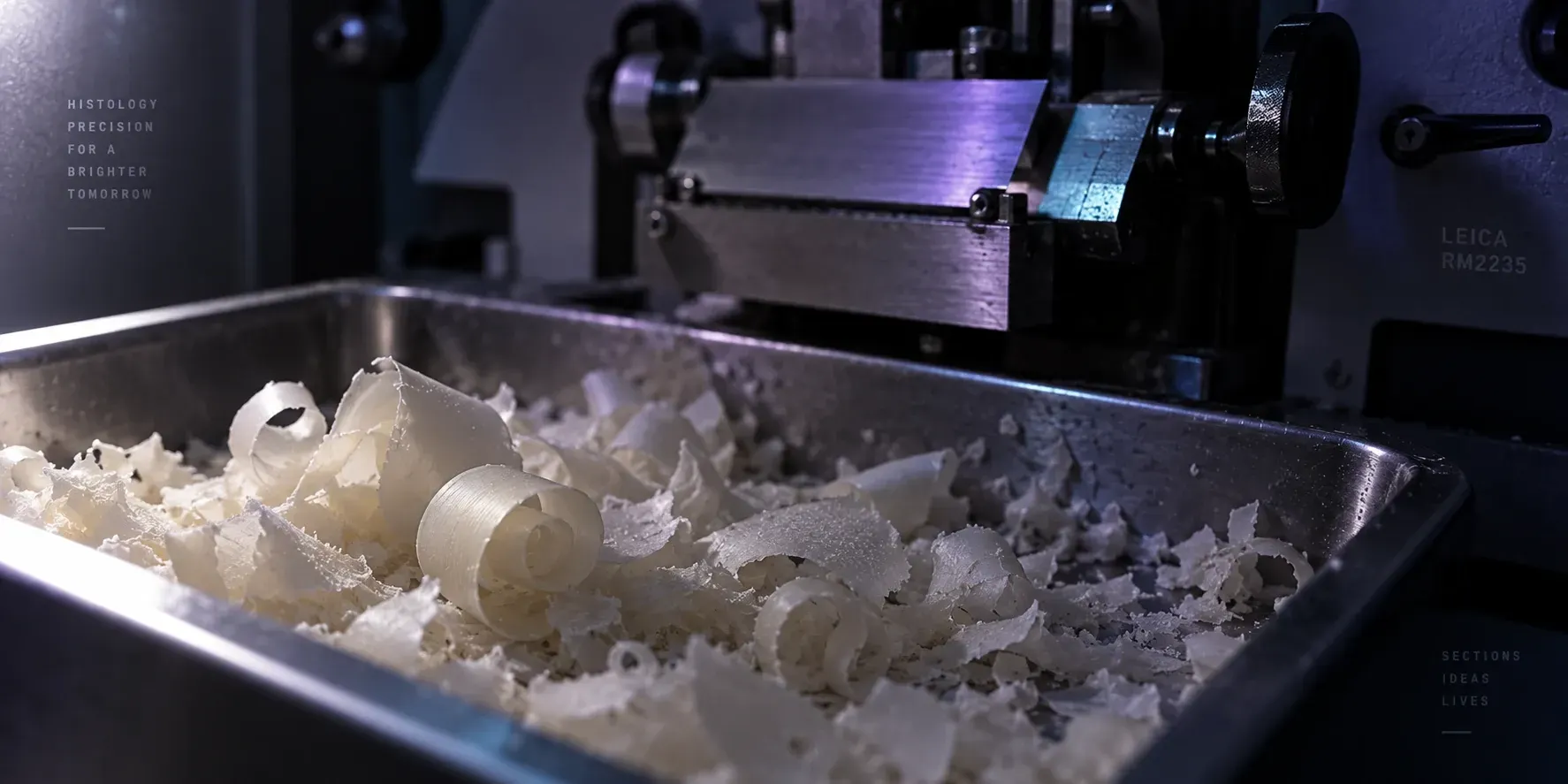
A histology page ran a poll asking readers to name the single most heart-dropping moment in the job, and offered three candidates. The crunch on the microtome blade. A tiny biopsy block loose in the processor. A freshly stained slide meeting the tile floor.
The poll wanted a vote. It got a catalog.
Within a day the comments had produced a fourth entry, then a fifth, then submissions that gave up on numbering. Almost nobody picked from the menu. The thread instead did what histology threads reliably do, which is reconstruct the entire workflow out of its failure points, one comment at a time, in no particular order and with considerable accuracy.
The three original options were well chosen. Each names a different flavor of irreversibility.
The crunch is not really about the blade. It is an audio report on something that should not be in the block and is now in the ribbon: a staple, a suture, a fleck of calcification, a bit of bone that decal never reached. Recognition arrives before the hand stops moving. By the time the wheel completes its turn, the face is scored and the next several sections carry the mark.
A block floating loose in the retort is worse in a quieter way, because the damage is administrative as much as physical. Tissue that has left its cassette has left its name. Somewhere in the basket is a fragment that belongs to a person, and reuniting the two now depends on the run log, the color coding, and whoever loaded that rack.
The dropped slide earns its place because of when it happens. Everything upstream already worked. Fixation held, the processor ran, the block behaved, the section floated flat, the stain came up clean, and then the object met the floor at the last possible moment before it became evidence.
The additions from the comments filled in the rest of the bench. A biopsy departing the forceps at embedding, which converts a two millimeter specimen into a search conducted at eye level with a flashlight and a wax scraper. Arriving in the morning to find the processor lid open and the chamber dry, which is not one case but every case in the run. A rack of freshly cut, unbaked slides going onto the stainer with the wrong color handle, dropping straight into alcohol instead of the oven, and the case is prostate cores. Someone summed up the small specimen problem in five words about seeing it and then not seeing it. Someone else described the automated coverslipper taking out its feelings on a tray of slides, which is how instruments get talked about in every lab where they have moods that no maintenance log explains.
Read the additions together and a pattern shows up in what triggers the drop.
Very few of these moments involve making a mistake, and none of them involve being told about one. The stimulus is almost always sensory and almost always precedes conscious reasoning by a beat: a sound with the wrong texture, a weight that is not on the forceps anymore, a rack in a position it should not occupy, a chamber that is dry when it should be wet. The stomach reacts, and the explanation catches up a second later. That gap is not anxiety. It is pattern recognition running faster than language, built out of years of hearing what a normal block sounds like, and it is one of the few places where accumulated bench experience becomes visible to the person who has it.
The other pattern is that the list has almost nothing to do with being wrong and everything to do with being unable to go back. Errors are correctable. A misordered stain gets reordered. A thin section gets recut. The heart-drop is reserved for the moments when the tissue itself has changed state, and the specimen that would let you try again either does not exist or has already been consumed.
In pharma the same catalog runs with different labels and a harder floor under it. The rack is xenograft blocks from a terminal collection. The animals are gone, the study is closed, the tissue in that cassette is the entire supply for that arm, and a dry retort or an opened cassette does not produce a recut request. It produces a deviation, a conversation with a study director, and a permanent hole in a dataset that someone will later try to interpret around.
One comment in the thread ignored the microtome entirely and answered that your company was just sold. It collected a crying reaction and no objections, because it fits the category exactly. Information arrives without warning, the ground changes state, and nothing about the next hour is under your control. The bench version and the org chart version of that feeling are the same feeling.
My own addition was a fifth entry: you see a fingertip in the microtome waste tray and realize it is yours. Someone replied with a scoreline, blade over fingertip, and told everyone to stay safe.
The joke works because it inverts the whole genre. Every other item on the list is about somebody else's tissue. The finger is about yours, and it is the only specimen in the story that arrives with no requisition, no accession number, no cassette, and no chain of custody. A lab organized around the principle that no fragment of a person should ever lose its identity contains exactly one piece of tissue that nobody logs, and it is currently operating the handwheel.
There is a real version of this underneath the joke, and everyone who laughed at it knows the real version. Blade injuries at the microtome are ordinary. They happen while changing blades, while clearing wax from the stage, while reaching for something during a moment of divided attention, usually to a tech who has cut ten thousand blocks and knows the machine well enough to stop looking at it. The hands are the part of the process that never gets validated, never gets a maintenance schedule, and never appears in the turnaround time report, and they are also the only component that cannot be replaced when a lot goes bad.
The poll asked for one answer and never got one. Twenty-one comments later there was no winner, just an unintentional map of the workflow drawn from the outside in, with a marker at every station where something irreplaceable can stop being what it was. The people who drew it were not trying to make a point. They were recognizing each other, which is what the laugh is for, and then they went back to a bench and put in a fresh blade.
Thin Sections is written by Jerry Clarin, HT (ASCP). The views expressed are his own and do not represent any employer.
You already do the work these essays describe. Thin Sections gives it a name. Free, every other week, from one bench to yours.